Cloud Infrastructure & Platform Engineering
Scalable cloud solutions on AWS & Kubernetes. I modernize legacy systems to reduce costs and build robust platforms that grow with your business.
Modern software systems must be designed to survive change. I help organizations move beyond tightly coupled monoliths to evolutionary cloud-native architectures that scale with business demand. My focus is on decoupling complexity to improve observability, testability, and developer velocity.
The Strategic Context: Cloud-Native Maturity
Reliability is a property of the system, not the code. In 2026, a robust architecture implies more than just microservices—it requires a platform that enforces best practices in CI/CD, Observability, and Infrastructure as Code. While we build for stability today, we also architect for the high-throughput demands of the future, such as RAG pipelines and Wafer-Scale integration.
Measuring the Advantage
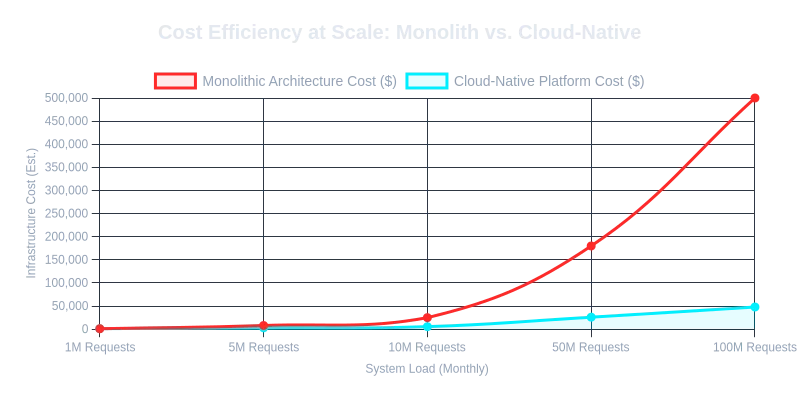
Transitioning to this architecture delivers measurable ROI. As shown in the Cost Efficiency at Scale graph below, the evolutionary platform approach decouples infrastructure cost from traffic growth. While monolithic legacy systems hit “vertical scaling walls”—causing exponential cost spikes—our cloud-native design maintains a near-linear cost profile even as load increases 100x.
This efficiency mirrors the findings in the Wafer-Scale AI Compute research [1], where specialized offloading prevents the main optimization loop from stalling.
Core Engineering Competencies
Legacy Modernization (The “Strangler Fig” Pattern)
Safely migrating critical business logic from legacy backends (.NET/PHP) to decoupled microservices without operational downtime.
- Microservices Migration: Proven track record decoupling monolithic systems (e.g., GoTech, Rapid7) to enable independent scaling.
- Evolutionary Design: Implementing architectures that support guided, incremental change.
Platform Engineering & Kubernetes
Building “Golden Paths” for internal development teams using AWS and Kubernetes.
- Infrastructure as Code (IaC): Terraform & CloudFormation for reproducible environments.
- Container Orchestration: Production-grade EKS (Elastic Kubernetes Service) management.
High-Throughput & Specialized Integration
While core services run on standard Kubernetes nodes, I design patterns to seamlessly offload intensive tasks—like “Liquid” model updates or high-bandwidth processing—to specialized resources.
- Async Offloading: Infrastructure capable of supporting heavy models and data streams without blocking the main event loops.
- Future-Proofing: Preparing systems for next-gen integration (e.g., Neuromorphic or Wafer-Scale clusters) via standard APIs.
Visualizing Cloud-Native Scale
This architectural approach is visually defined in the diagram below. The vertical structure separates the Platform Engineering foundation (IaC, CI/CD) from the active Kubernetes Runtime, while explicitly designating a zone for High-Performance Offload (like Wafer-Scale Compute). This separation enables the core services to remain stable while specialized workloads scale independently.

Value Proposition
It is significantly more cost-effective to design for failure than to repair it. My architectural audits identify bottlenecks and single points of failure today, while my strategic planning ensures your infrastructure is ready for the specialized compute demands of tomorrow.
Key Deliverables
- Architecture Decision Records (ADRs): Documenting the “why” behind system design decisions.
- Migration Strategy: A roadmap for moving from legacy monoliths to evolutionary microservices.
- Cloud Cost Optimization: Rightsizing infrastructure to reduce AWS spend immediately.
- Platform Evolution Strategy: Roadmaps for Internal Developer Platform (IDP) maturity and specialized hardware integration.